Perceive-Reason-Code: Active Perception for Document VQA
Code: github.com/bdsaglam/docvqa · Poster (PDF)
TL;DR
We jointly won the 8–35B tier of the ICDAR 2026 DocVQA challenge. An open Qwen 3.5 27B beat the challenge’s bare-model baselines, the much larger Gemini 3 Pro and GPT-5.2, on the held-out test set. Our agent is a code-capable model in a Python REPL with one perception tool, a vision model it can point at any region of any page, so it decides where to look instead of reading whole pages at a fixed resolution. Ablations show the gain needs both parts together, and that the usual additions (a general sub-agent, context compaction, the OCR and search our competition entry used) add nothing or cost accuracy. No model can resolve a dense page in one fixed-resolution look, so accuracy depends on how well the looks are directed, and directing them is the reasoner’s job: scaling the reasoner moves accuracy about twice as much as scaling the VLM it looks through, and a strong coding reasoner driving a small VLM beats a small reasoner driving a strong one. The approach builds on RLM, CodeAct, and the visual-programming line; the contribution is the combination for documents, with ablations behind every claim.
We jointly won the 8–35B tier of the ICDAR 2026 DocVQA challenge with Qwen 3.5 27B: on the held-out test set, our agent beat the challenge’s bare-model baselines, including the far larger Gemini 3 Pro and GPT-5.2. The agent is a code-capable model working in a persistent Python REPL, with an on-demand call to a vision-language model (VLM) it can point at any region of any page.
We wanted to understand which parts of the agent earned the score, so we ablated the harness on the validation set. The gain comes from the REPL and the perception call together; removing either collapses it, and the usual enrichments (a general sub-agent, context compaction, an OCR pipeline) add nothing or cost accuracy. The ablations also say where to spend. No model can afford to read a dense page in a single fixed-resolution look, so accuracy depends on the looks being directed well, and directing them is the reasoner’s job: scaling the reasoner pays about twice as much as scaling the VLM it looks through.
The result
The challenge scores one submitted answer per question on a held-out test set; we compute each of ours by self-consistency voting over a handful of samples. Two of the entries below are ours. The tuned entry is what we submitted to the competition, fitted to this benchmark with DocVQA-specific prompts plus OCR and search. The general method drops all of that and still clears the frontier baselines; it is the agent the rest of this post describes and ablates. The baselines are bare models with no agentic scaffold, so the fair reading is a harnessed 27B against unharnessed frontier models.
| System (held-out test set) | Score |
|---|---|
| Qwen 3.5 27B (ours), tuned entry | 43.8% |
| Qwen 3.5 27B (ours), general method | 39.4% |
| Gemini 3 Pro | 37.5% |
| GPT-5.2 | 35.0% |
| Gemini 3 Flash | 33.8% |
| GPT-5 Mini | 22.5% |
The test numbers sit below our validation numbers. A harder test split is at least as plausible a cause as fit to the set we developed against, and the general method strips most of the benchmark-specific prompting, so we don’t read the gap as mostly overfitting; still, we don’t claim the validation figures transfer untouched to test.
How the score was reached matters more than the position. Strong document-VQA systems usually get there by fine-tuning on tens of thousands of question-answer pairs, or by building a specialized OCR-and-encoder pipeline. The general method needs neither. The model is stock Qwen 3.5 27B, the harness is a REPL and one perception call, and on this task that harness substituted for fine-tuning. Before you reach for training data or a specialized pipeline, it is worth seeing how far a general model gets when you let it direct its own perception.
The challenge
In document visual question answering (Mathew et al., 2021), the input is a document and a question in plain language. The hard part is what counts as a “document.” In the ICDAR 2026 challenge a single item might be a one-page infographic or a 281-page annual report, and the answer might be a value in a merged table cell, a label on an engineering drawing, a figure on a crowded chart, a date in a form, or something you only get by reading two pages and doing arithmetic.
Before any reasoning happens, the evidence has to be found, and the finding runs along two axes. Across pages, the answer lives on one page out of up to 281, so the right page has to be located first. Within a page, the page can be thousands of pixels on a side and dense with labels, cells, and lines, so the answer occupies a fraction of it well below what a single fixed-resolution read can resolve. A general-purpose VLM handed all the pages at once reads each at a fixed resolution with a fixed slice of attention, which works on a sparse page and fails on a large, dense one.
Documents across the challenge run from a single page to 281 with a median of 8: most are short, and the tail is long.
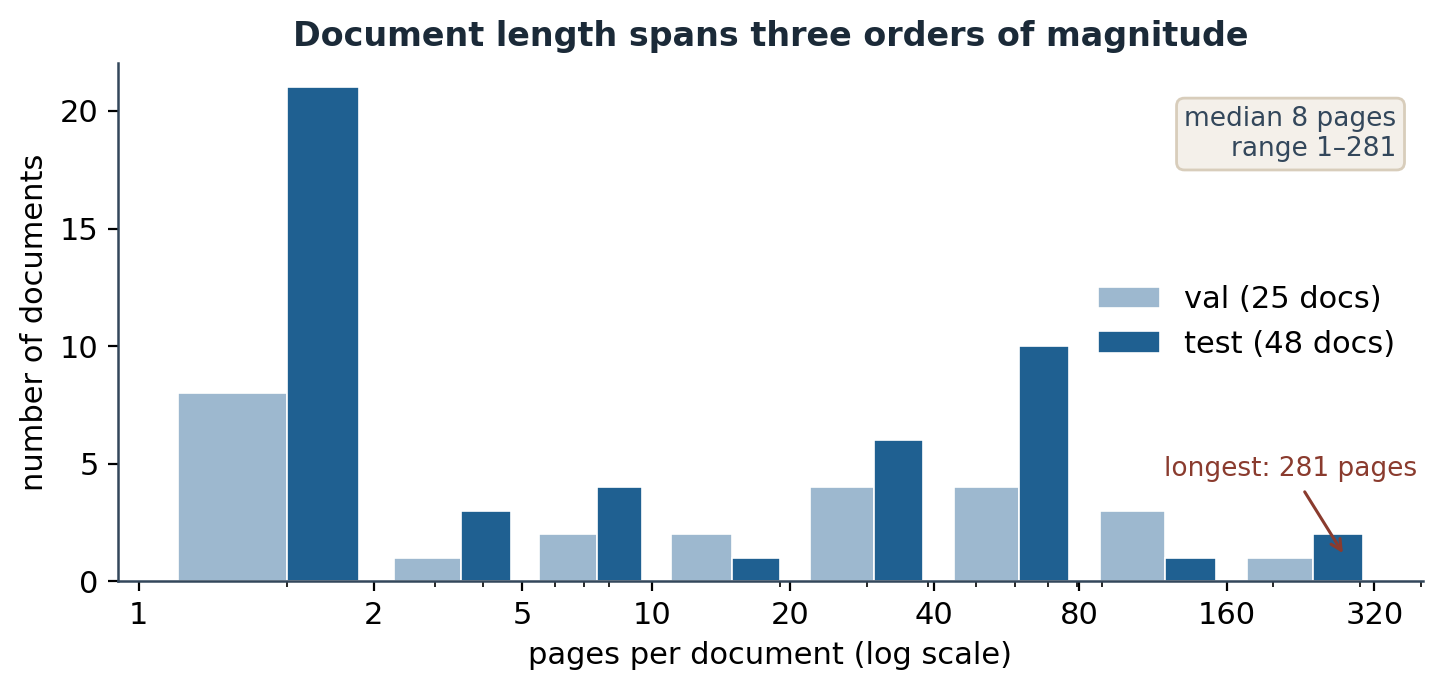
Figure 1. Document length across the DocVQA-2026 validation and test sets.
The obvious responses to that gap are a bigger model or more pages stuffed into the context window. What worked was letting the model decide where to look.
The method
Picture how a person answers a question from a hundred-page report. They don’t read every page at a uniform squint. They flip to the section that matters, lean in on the one figure or table the question turns on, re-read a caption when a number looks wrong, and do the arithmetic on a notepad. The same holds on a single sheet: hand someone a large, dense map and they still work it region by region, the legend first, then the area they need, then the labels there. Active perception gives a model the same habit.
We give a code-capable model a persistent Python REPL and one perception primitive, an on-demand VLM call pointed at any region of any page. The model can crop to the evidence, zoom for acuity, sweep pages in a loop, composite regions, and do in code the coordinate math and arithmetic a VLM is bad at. The name Perceive-Reason-Code follows the loop: the model perceives through the VLM call, reasons in language, and acts by writing code.
Unless noted otherwise, every experiment below uses Qwen 3.5 27B as both the reasoner and the VLM, on the DocVQA-2026 validation set (25 documents, 80 questions), eight trials, scored by ANLS (the fuzzy string-match metric DocVQA uses), reported as mean ± std.
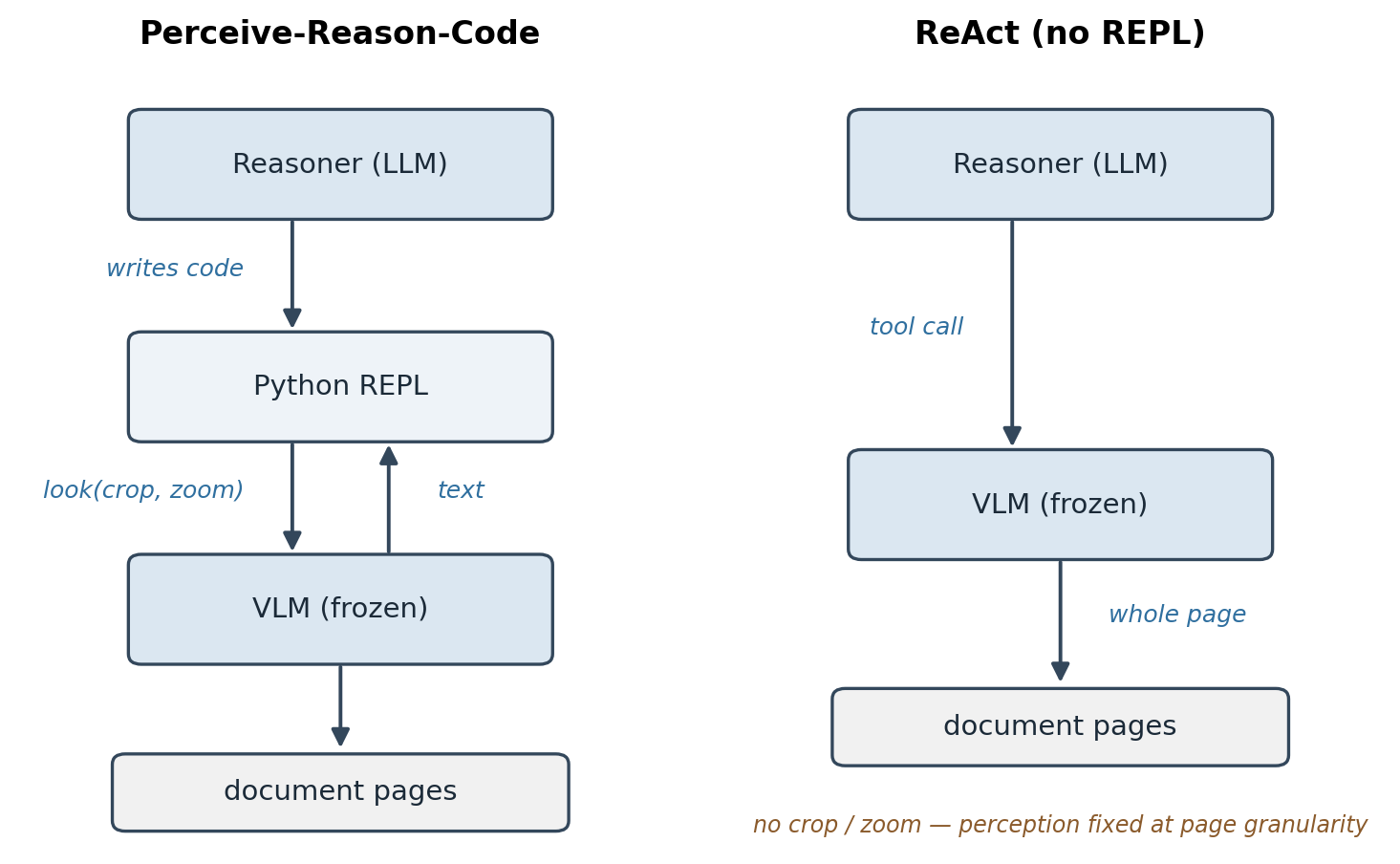
Figure 2. Left: the active-perception loop. The reasoner writes code, the code calls the VLM on a chosen crop, and the returned text flows back into the REPL as the next observation. Right: a ReAct agent (Yao et al., 2023): the same VLM through plain tool calls, no code environment, so it reads only whole pages with no way to crop, compose, or compute.
The loop is the familiar agent shape of state, action, and observation: the state is a representation of the run so far, an action is a block of Python the model writes, and an observation is whatever that code prints, including the text a perception call returns.
Here is one run of the loop on a real question, the gap between two values on a chart buried in a 181-page report.
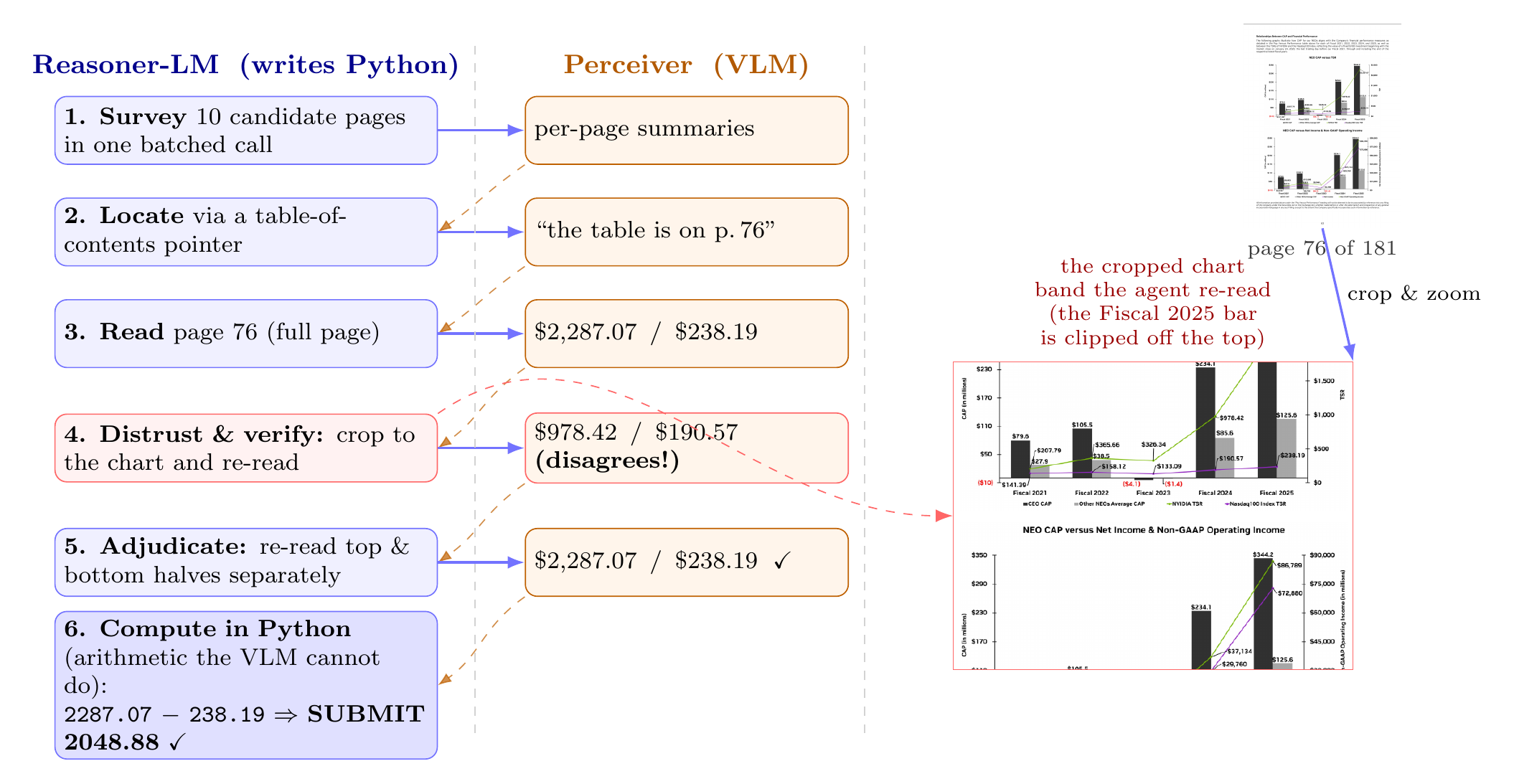
Figure 3. One run of the loop (16 iterations, correct). It surveys ten candidate pages in one batched call, locates the table via a table-of-contents pointer, reads a page whole and distrusts the number it gets, crops to the chart band and re-reads, then does the subtraction in Python, where it’s exact.
The whole-page read returned $978.42, which was wrong; the crop and re-read caught the right value.
One setup detail: these runs disable the model’s native “thinking” channel.1 The reasoning still happens, in the visible body of each turn where the code and the comments live.
Ablations
The harness has a few moving parts: a Python REPL, a VLM that the agent calls as a perception tool, and the loop that ties them together. We ablate each in turn. Every run keeps the same answer-formatting rules; only the structure changes.
Two configurations run the full loop, and they need names. RLM, the one our entry ran and the one every headline number in this post reports, is a direct instance of the Recursive Language Models scaffold and conditions on a compacted state (a sliding window of recent REPL steps). CodeAct runs the same loop but conditions on the full transcript of every turn. Both do active perception; they differ only in how they represent the trajectory, a difference one ablation below treats on its own. ReAct keeps the same VLM perception tool but has no REPL.
Here are the main configurations, one per row. avg@1 is the headline single-trial accuracy (mean ± std over eight trials); the last two columns are two diagnostics behind it, pass@8 (coverage, whether any of the eight trials is correct) and SC@8 (the self-consistency vote we actually submit).
| Configuration | avg@1 (± std) | pass@8 | SC@8 |
|---|---|---|---|
| RLM (full method) | 41.9 ± 5.8 | 68.8 | 47.5 |
| + general sub-agent | 36.7 ± 2.8 | 66.3 | 41.3 |
| + OCR & search | 36.6 ± 2.9 | 67.5 | 40.0 |
| CodeAct | 39.5 ± 2.8 | 63.8 | 45.0 |
| ReAct (no REPL) | 27.2 ± 3.2 | 53.8 | 32.5 |
| Raw multi-image (no scaffold) | 20.9 ± 1.6 | 27.5 | 20.0 |
| Competition prompt (no scaffold) | 18.9 ± 1.9 | 33.8 | 21.3 |
| OCR-only (no vision) | 14.7 ± 2.2 | 27.5 | 15.0 |
The two diagnostic columns are worth reading before the ablations. Self-consistency (SC@8) buys a few points over a single trial, which is why our test submissions vote. And pass@8 sits far above single-trial accuracy on the strong scaffolds, 68.8 against an avg@1 of 41.9 for RLM and 63.8 against 39.5 for CodeAct: the scaffold’s sampling reaches the answer far more often than it reliably produces it. (pass@8 is also the upper bound for any way of picking among the eight; SC@8 is one realizable pick, and it recovers only part of the gap.)
The first ablation removes the REPL. What’s left is a ReAct agent: the same VLM perception tool, but called through plain tool use instead of from inside a code environment. The score falls from 41.9% to 27.2%. Without a REPL the agent can’t crop a region by arithmetic, can’t tile a page, can’t subtract two numbers it just read; it asks for whole pages and stops early, around five steps per question. The REPL is what turns reasoning into targeted perception.
The second ablation keeps the REPL and removes the perception call. The agent gets a display() that loads page pixels straight into its own context, so it looks at the document itself instead of asking a focused VLM call to look and report back. (This is DeepEyes’ perception channel driven from a REPL, except that DeepEyes trains the habit with RL and here it is prompted.) Accuracy collapses to 22.3%, and the agent thrashes: it runs 30+ steps per question and pins the iteration cap on most of them, grinding without converging.
That second result is what the RLM line predicts. Stuffing raw content into the reasoner’s own context degrades it, the familiar context-rot effect where a model handles a long or noisy context worse than a clean one. RLM tells this story for long text; the same thing happens with pixels. A REPL alone is not enough: the perception has to go through a call that returns compact text, rather than being poured into the reasoner’s own window.
The two ablations fill a 2×2:
| w/ sub-VLM | w/o sub-VLM (pixels in-context) | |
|---|---|---|
| w/ REPL | 41.9% (full method) | 22.3% (display() only) |
| w/o REPL | 27.2% (ReAct) | 20.9% (raw multi-image, no scaffold) |
Drop either half and accuracy lands in the low-to-mid 20s, near the no-scaffold baseline. The gain needs the code REPL and the on-demand VLM call together.
Plotted together, the configurations fall into three tiers whose gaps dwarf the spread within each.
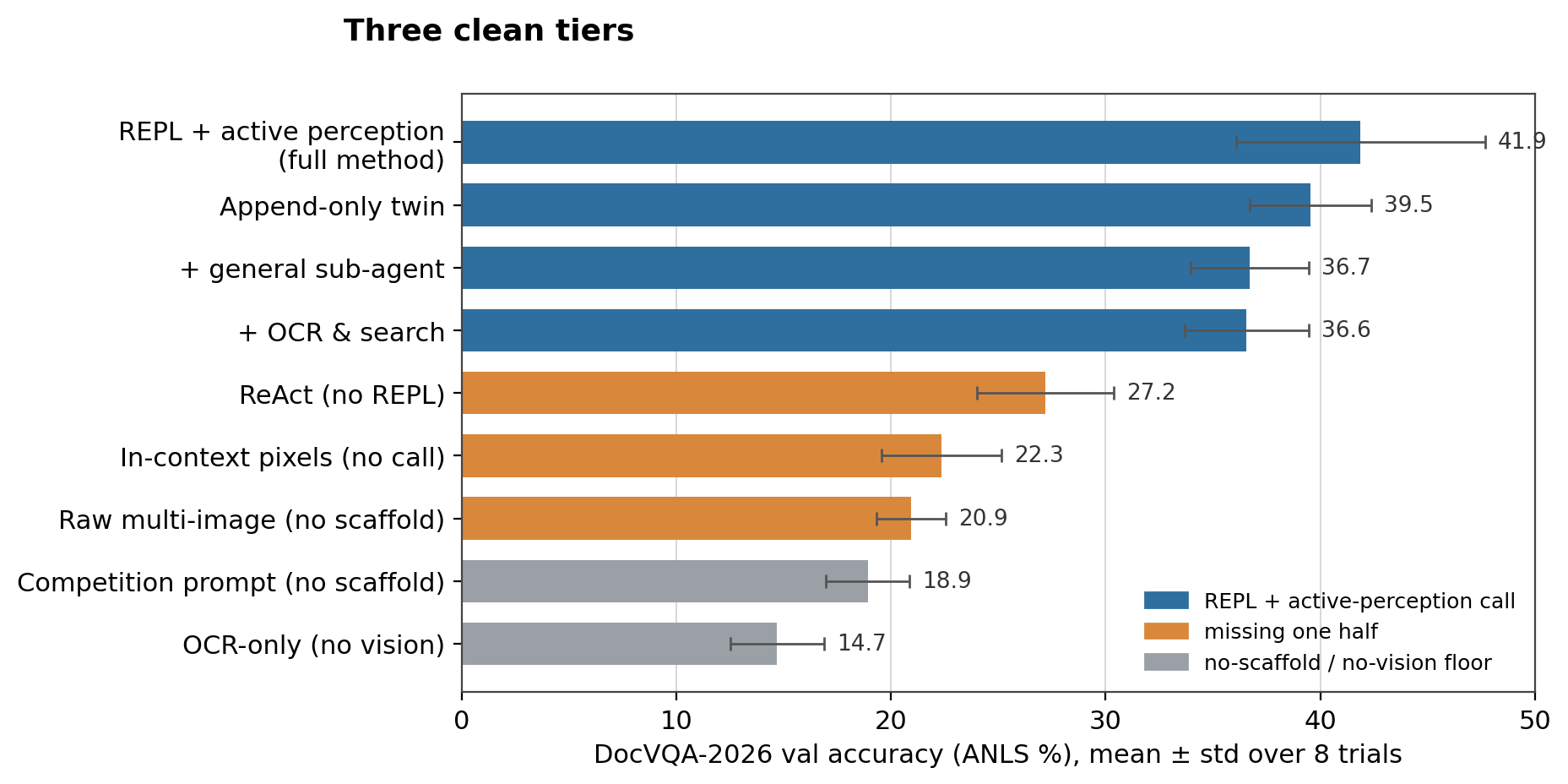
Figure 4. Validation accuracy (avg@1 ± std, eight trials each) for every configuration, colored by tier: REPL + active perception, missing one half (no REPL or no perception call), and the no-scaffold / OCR-only floor.
Three things that don’t help
The obvious ways to enrich the core add nothing, and two of the three cost accuracy.
Generalizing the call costs points. We replaced the focused “look at this region” call with a general sub-agent that could take on any subtask (image optional). Accuracy regressed to 36.7%, five points below the plain call, and when we logged what the agent actually asked the sub-call to do, about 99% of the calls were still plain perception. One focused perception primitive captures the benefit; the extra generality is overhead. (We use one level of perception call throughout; we never tried stacking them deeper.)
The trajectory format doesn’t matter for accuracy. RLM conditions on a compacted representation of the run, a sliding window of its recent REPL steps. CodeAct keeps the full trajectory instead, never compacting. The two tie, 39.5% against 41.9%, and CodeAct doesn’t lose ground on longer documents (the per-document gap is uncorrelated with page count).
The format does matter for training. Methods for training an agent, whether by reinforcement learning or by distilling a stronger one, assume the model’s output grows as a clean prefix: turn t is turn t−1 with more appended. Compaction rewrites the history between turns and breaks that assumption; the full trajectory keeps it, and as the tie shows, choosing it costs nothing in accuracy. (Making compacted trajectories trainable anyway is its own open problem; FoldAct (Shao et al., 2025) is an early attempt.)
Our OCR pipeline costs accuracy when added on top. The pipeline is docling for layout-aware page text, IBM granite-vision (a 2B vision-language model) for captioning the embedded figures and charts, and a BM25 index for lexical search. Wired into the full method, it drops the score to 36.6%. The mechanism is visible in the trajectories. OCR reads each page whole, in one fixed pass with no crop or zoom, so on dense regions its parse is unreliable. And because the parse arrives as confident text, the reasoner leans on it instead of aiming the perception call: it takes a misread value or a flattened table at face value and answers without a verifying look, even though its prompt says to check critical values visually. This is a verdict on the pipeline we ran, not on OCR in general; a stronger engine, better matched to these layouts, might surface detail ours missed.
Passive perception is the floor
The reasoner in the full method never looks at pixels; everything it knows arrives as text a VLM reported about regions the reasoner chose. The last ablation keeps the reasoner, the REPL, and the text interface, and changes only where the text comes from. The agent now works over the output of our OCR pipeline, built once per document before any question is asked: page text, a small VLM’s captions for the figures and charts (so the channel even contains some vision), and a search tool over it all. It scores 14.7%, the floor of the study, below even the no-scaffold competition prompt, with zero out of ten on layout-bound categories (engineering drawings, maps) in all eight trials.
Some of the floor is simple quality: the pipeline’s perceiver is small, it reads whole pages, and its misreads are baked in. But quality is not the main story. Hand the same reasoner a far weaker perceiver than its usual 27B, a 4B VLM, and let it drive it region by region, and it scores 32.8 (next section), more than double the passive channel. What collapses at 14.7 is not perception but agency over it. Every page was read once, whole, and question-blind, and no amount of searching that transcript recovers what a directed look would have caught.
Better eyes, or a better director?
The ablations pin the scaffold’s contribution to perception: swap whole-page ReAct for RLM with the same 27B on both sides, and accuracy jumps from 27 to 42, with nothing changing but how perception is spent. To see where the remaining headroom lives, we scale each half separately: 4B, 9B, and 27B Qwen as the reasoner, crossed with the same three sizes as the VLM behind the perception call.
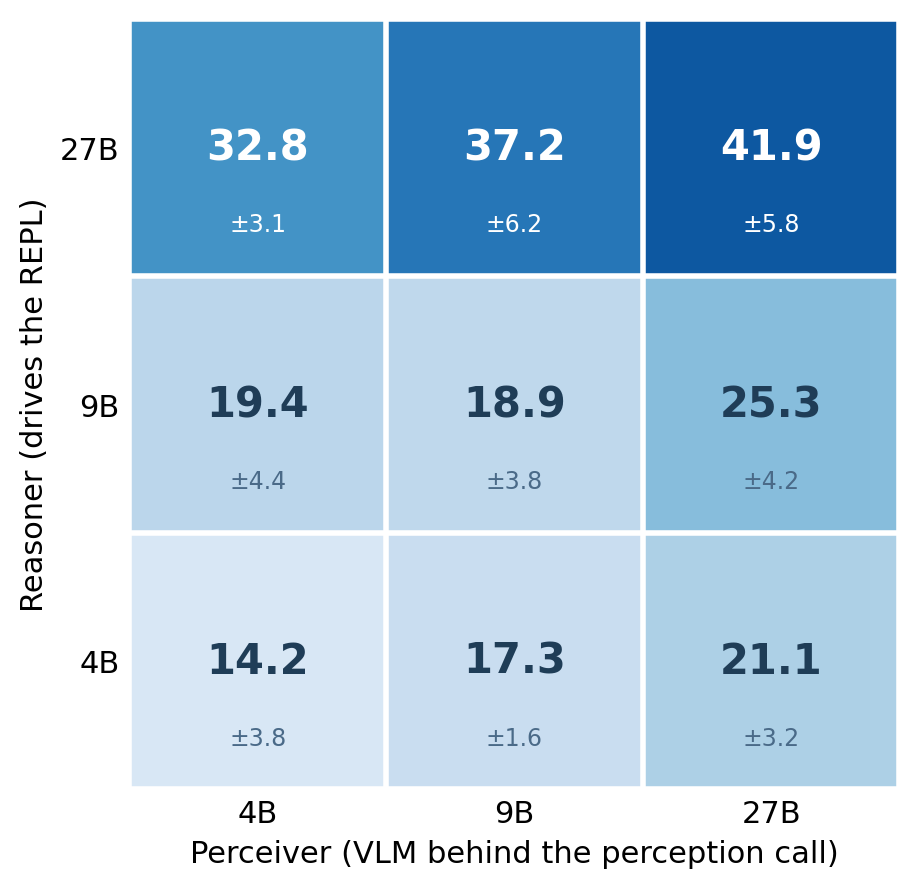
Figure 5. Validation accuracy (ANLS %, mean ± std over 4–8 trials per cell) for each reasoner × VLM pairing of Qwen 3.5 4B/9B/27B, all under the same RLM harness. The 27B row and the mixed 4B-reasoner/9B-VLM and 9B-reasoner/4B-VLM cells use the exact configuration reported everywhere else in the post; the remaining cells use a minimally different prompt variant of the same solver (identical harness and tools).
Across a row of the matrix, the reasoner stays fixed and only the eyes improve. Upgrading to 27B eyes pays at every reasoner size, well outside the noise:2 +6.9 end to end on the 4B row, +6.4 from 9B eyes on the 9B row, and +9.1 end to end on the 27B row (32.8 with 4B eyes, 37.2 with 9B, 41.9 with 27B). The smaller upgrade, 4B eyes to 9B, is inside the noise at every reasoner size; for the 9B reasoner the two cells are an outright tie (19.4 and 18.9).
Down the rightmost column, the VLM stays at 27B and the reasoner scales, and accuracy nearly doubles. That leverage needs the loop. Put the same ladder of reasoners behind ReAct:
| Reasoner | RLM | ReAct |
|---|---|---|
| 4B | 21.1 | 18.1 |
| 9B | 25.3 | 22.7 |
| 27B | 41.9 | 27.2 |
Going from a 9B reasoner to a 27B one adds +16.6pp in RLM but only +4.5pp in ReAct: the same extra reasoning capacity is worth three to four times as much when the model can spend it through the loop. A whole-page reader can think harder about a page it still cannot resolve, so its ceiling is whatever one downsampled look yields. Give the same reasoner a perception tool and its capacity turns into accuracy: it writes tighter crops, cleaner code, and decides where to look again.
The two mixed corners of the matrix make the trade concrete. A 4B reasoner given the 27B VLM reaches 21.1. A 27B reasoner peering through the 4B VLM reaches 32.8, and it even clears the ReAct agent that has the full 27B as its eyes (27.2). Between a stronger VLM and a stronger director, buy the director.
If perception is the bottleneck, the advantage should be largest where a page packs the most fine detail, and it broadly is.3 The per-category gap between the RLM agent and the ReAct baseline tracks visual density, though with few questions per category the ranking matters more than the exact points:
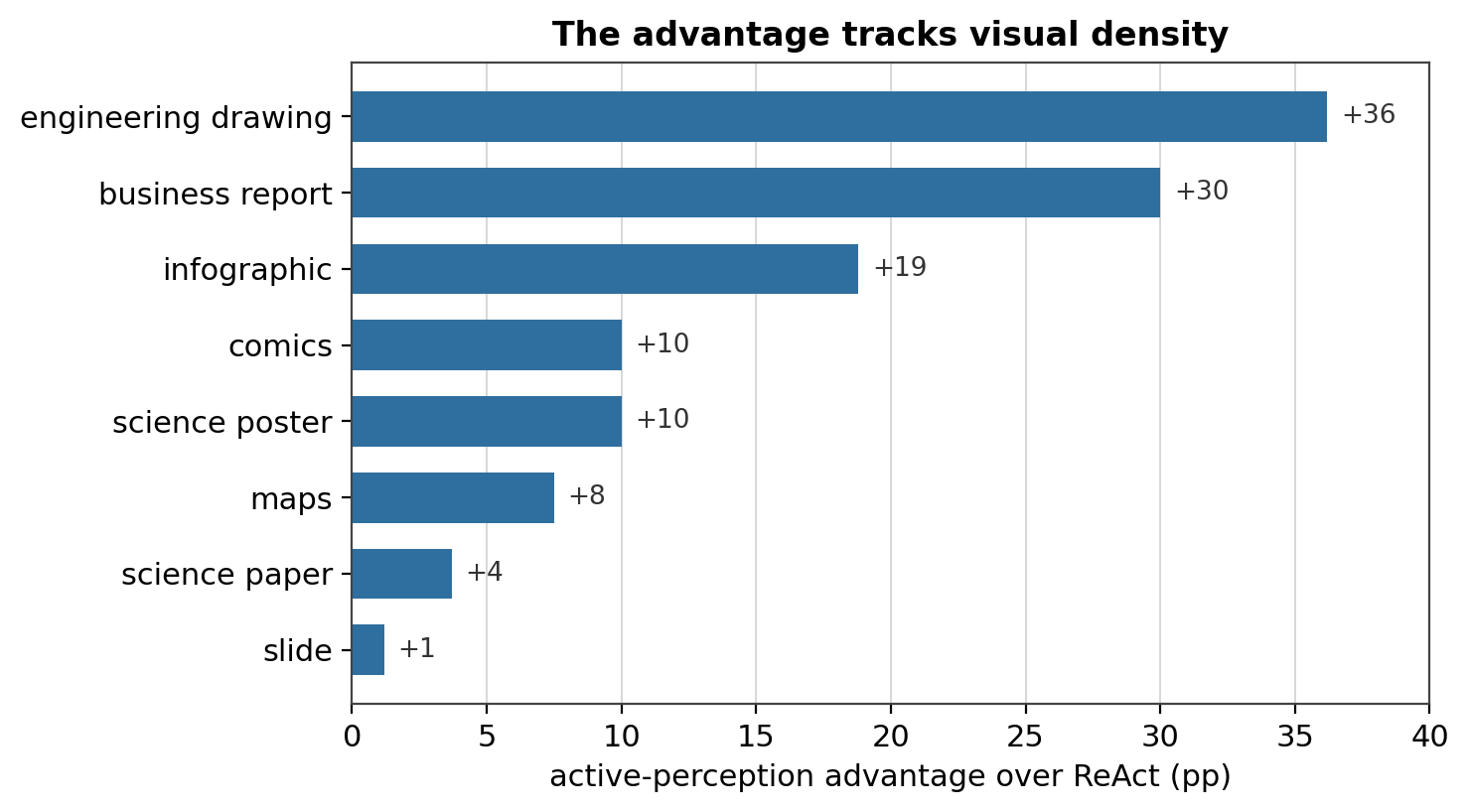
Figure 6. RLM’s advantage over ReAct (ANLS points), by document category: engineering drawings +36, business reports +30, infographics +19, science papers +4, slides +1. Maps are a hard case for every configuration.
So is the bottleneck perception or reasoning? Perception is what binds in the moment: no single look resolves a dense page, and perception done in advance does not replace directed looks. The leverage sits with the reasoner: at a fixed 27B VLM, scaling the reasoner adds +20.8 points, while at a fixed 27B reasoner, scaling the VLM adds +9.1, and the reasoner’s leverage exists only inside the loop, as ReAct’s much shallower column in Table 4 shows.
One caveat bounds the reasoning half of this. The data does not separate how much of a stronger reasoner’s gain comes from sharper aiming (better crops and code) and how much from sharper reasoning over what it then sees. That decomposition stays open.
The gain holds across model sizes and families
Our entry used Qwen 3.5 27B, but nothing in the method is specific to it. To check, we run the harness homogeneously (the same model as both reasoner and VLM) across sizes and across a second family.
| Model | ReAct | RLM | CodeAct |
|---|---|---|---|
| Qwen 3.5 4B | 13.4 | 14.2 | 16.3 |
| Qwen 3.5 9B | 16.3 | 18.9 | 23.0 |
| Qwen 3.5 27B | 27.2 | 41.9 | 39.5 |
| Gemma 4 31B | 18.4 | 33.0 | 30.3 |
| Gemma 4 E4B | 6.1 | 7.3 | 7.8 |
The code-REPL harnesses (RLM and its CodeAct twin) beat the no-REPL ReAct agent at every capable size, and the margin grows with model capability: a point or two at 4B, about fifteen points at Qwen 27B and Gemma 31B. The gain is gated by capacity, though. Gemma 4 E4B falls below the gate: no harness clears the no-scaffold baseline (around 6), because the model cannot write the code to drive the loop. The harness amplifies a capable coder; it cannot rescue a model that cannot code. Any model that is a strong enough multimodal coder gets the benefit, and Qwen 3.5 27B is simply the one we entered in the challenge.
The advantage grows with document length
Document length is an axis of its own. To see its effect, we run RLM and the raw multi-image baseline on two benchmarks of very different length: MP-DocVQA (short, at most 20 pages, mean 5.3, scored by ANLS; Tito et al., 2023) and MMLongBench-Doc (long, around 47 pages, scored by a Qwen judge; Ma et al., 2024). Both on stratified-random subsets, n=3, Qwen 3.5 27B.
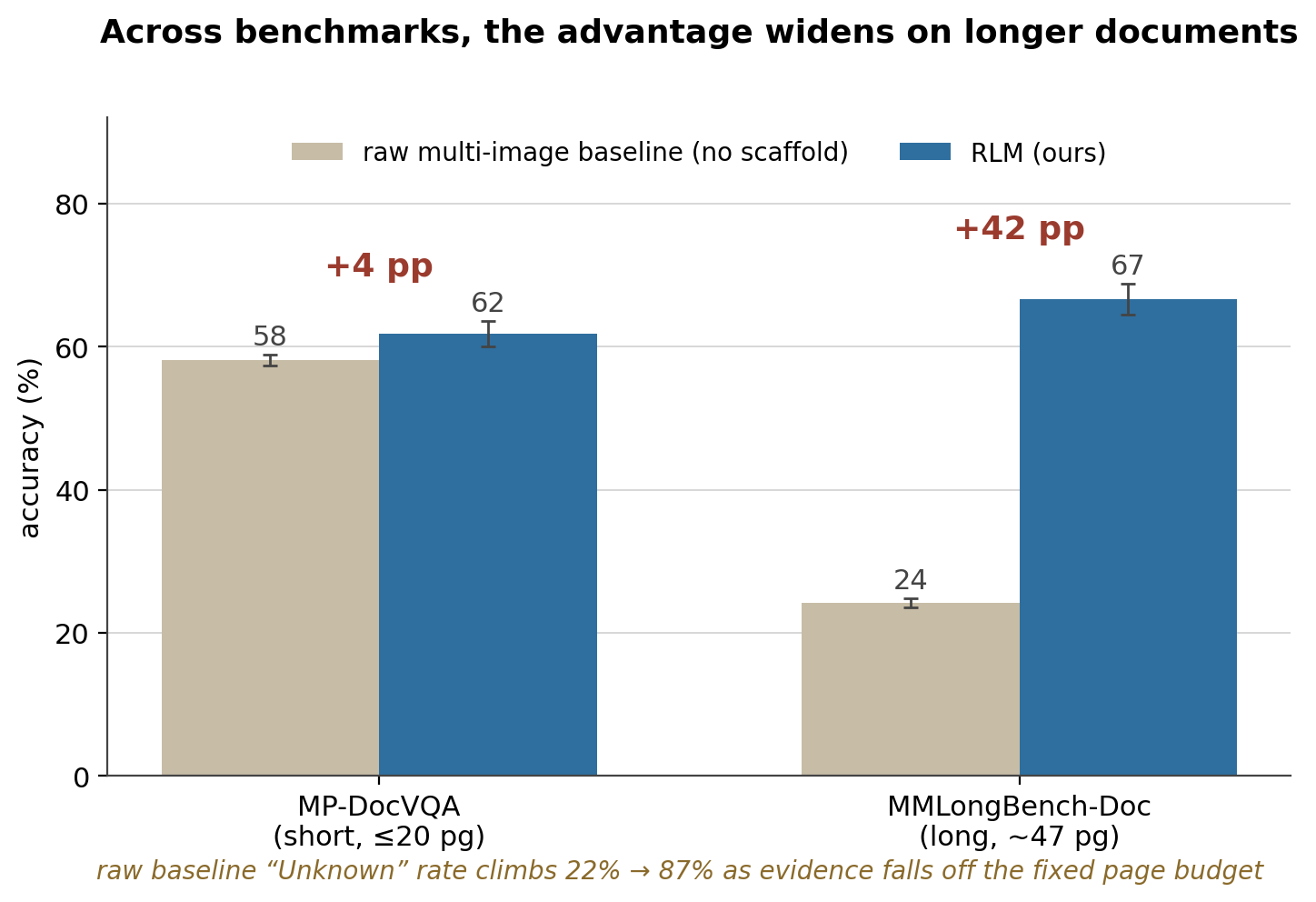
Figure 7. RLM’s advantage over the raw multi-image baseline on MP-DocVQA (short documents) and MMLongBench-Doc (long). Qwen 3.5 27B, n=3, mean ± std.
On the short benchmark the gap is about 4 points (61.8 against 58.1); on the long one, about 42 (66.6 against 24.2). The baseline is the same raw multi-image configuration as in the ablations, and nothing changed between the two benchmarks but the documents.
The mechanism is visible in how each method moves across the axis. RLM stays flat, because it navigates the document regardless of length. The raw multi-image baseline degrades as the evidence falls off the end of a fixed page budget: its “Unknown” rate, the questions where it cannot find the evidence, climbs from about 22% on short documents to about 87% on long ones.
On moderate collections like DocVQA-2026 the page budget barely binds, and the large edge there comes from the other axis, within-page density.
Limitations
The method pays for its generality in model calls. Perception happens a region at a time, each region is a VLM call, and the calls are sequential because each one depends on what the last one returned. The full method averages around 13 steps per question; the in-context-pixels variant, which never converges, runs more than twice that and pins the cap.
| Configuration | Steps / question |
|---|---|
| RLM (ours) | ~13 |
| ReAct (no REPL) | ~5 |
| In-context pixels (no perception call) | ~30 (caps out on most questions) |
| Raw multi-image (no scaffold) | 1 |
So the method trades latency and token cost for accuracy and generality. On the heaviest documents it can run up against the model’s context limit outright, and the self-consistency voting behind our test submission multiplies the cost several times over. This is the reason you’d hesitate to put this exact configuration in front of a latency-sensitive user. MADQA (Borchmann et al., 2026) shows how far the cost side can run: in their setting, an unconstrained recursive agent burned on the order of 270M input tokens and several hundred dollars on a task it then lost to a far cheaper retrieval agent.
Spending more steps does not buy a better answer, either: across questions, trajectory length is mildly negatively correlated with correctness. Long trajectories mark hard documents.
We left the efficiency measures untried, so there is clear room:
- Cut calls with cheap retrieval. High-quality OCR run once as preprocessing, plus a searchable index, would let the agent jump to the right page instead of sweeping: fewer perception calls for the same evidence. This also reframes the OCR result from the ablations. Our pipeline failed as an evidence channel, where its confident misreads displaced directed looks; pure navigation dodges that failure mode, because OCR only points at pages and every value the agent uses still comes from a look it aimed.
- Make each call cheaper. The reasoner and the VLM don’t have to be the same model. The cross-model runs price this trade: a 4B VLM behind the 27B reasoner keeps 32.8 of the 41.9, about three-quarters of the accuracy at a fraction of the per-call cost, and a document-specialized small VLM could close more of the gap.
Code as a substrate for learning
The REPL gives a neural model a symbolic substrate: a place to hold, compose, and compute over things its own context can’t. Active perception is one use of it. The model writes code to aim its own eyes, and the code does the cropping and the arithmetic that the network is bad at. The neural part proposes; the symbolic part executes and remembers.
Using this substrate at inference is already common: frontier models interleave code execution and tool calls with their reasoning. The results here add a document-domain instance, with the twist that the code aims a second model’s perception.
The open question is about learning. Everything above uses the substrate at test time, with frozen weights and the harness wrapped around them from the outside. What if it were woven into how the model is trained instead, so that composing, computing, and aiming its own perception became a native faculty rather than a scaffold bolted on from outside? That is a sharper and more uncertain claim than “code helps agents,” and it is the one we keep coming back to.
Two findings from this study ground the question. First, we know which form is trainable: the append-only trajectory ties the compacted one on accuracy while keeping the growing-prefix structure that learning methods assume. Second, the coverage gap is sitting there: for CodeAct, pass@8 is about 24 points above what a single trial reliably produces. The answer is already in reach; the model just does not land on it by default. That is exactly the signal a learning procedure exists to capture.
We got these results by letting a frozen model write code to look more carefully. The question we want to answer next is whether a model trained to use the substrate, with neural and symbolic computation learned together, outgrows one that only borrows it at test time.
References
- Zhang, A. L., Kraska, T., & Khattab, O. (2025). Recursive Language Models. arXiv:2512.24601.
- Mayumu, N., et al. (2026). Recursive Vision-Language Models with Adaptive Depth (RVLM). arXiv:2603.24224.
- Wang, X., et al. (2024). Executable Code Actions Elicit Better LLM Agents (CodeAct). ICML. arXiv:2402.01030.
- Yao, S., et al. (2023). ReAct: Synergizing Reasoning and Acting in Language Models. ICLR. arXiv:2210.03629.
- Gupta, T., & Kembhavi, A. (2023). Visual Programming: Compositional Visual Reasoning Without Training (VisProg). CVPR. arXiv:2211.11559.
- Surís, D., Menon, S., & Vondrick, C. (2023). ViperGPT: Visual Inference via Python Execution for Reasoning. ICCV. arXiv:2303.08128.
- Zheng, Z., et al. (2025). DeepEyes: Incentivizing “Thinking with Images” via Reinforcement Learning. arXiv:2505.14362.
- Borchmann, Ł., et al. (2026). Strategic Navigation or Stochastic Search? How Agents and Humans Reason Over Document Collections (MADQA). arXiv:2603.12180.
- Shao, J., et al. (2025). FoldAct: Efficient and Stable Context Folding for Long-Horizon Search Agents. arXiv:2512.22733.
- Mathew, M., Karatzas, D., & Jawahar, C. V. (2021). DocVQA: A Dataset for VQA on Document Images. WACV. arXiv:2007.00398.
- Tito, R., Karatzas, D., & Valveny, E. (2023). Hierarchical Multimodal Transformers for Multi-Page DocVQA (MP-DocVQA). arXiv:2212.05935.
- Ma, Y., et al. (2024). MMLongBench-Doc: Benchmarking Long-context Document Understanding with Visualizations. arXiv:2407.01523.
Citation
If you found this useful:
Sağlam, B. D. (2026). Perceive-Reason-Code: Active Perception for Document VQA. https://barisdeniz.is-a.dev/posts/perceive-reason-code/
@misc{saglam2026prc,
  author       = {Sağlam, Barış Deniz},
  title        = {Perceive-Reason-Code: Active Perception for Document VQA},
  year         = {2026},
  howpublished = {\url{https://barisdeniz.is-a.dev/posts/perceive-reason-code/}}
}
Footnotes
We run with
enable_thinking=falsefor cost and reproducibility. Re-enabling it doesn’t change the picture (a separate ablation moves it less than the trial-to-trial noise).↩︎4B row, 4B→27B eyes: +6.88pp (Welch t = 3.91, 95% CI [+3.1, +10.7]), eight trials per arm. 9B row, 9B→27B eyes: +6.41pp (t = 3.21, 95% CI [+2.1, +10.7]), eight per arm. 27B row, 4B→27B eyes: +9.07pp (t = 3.52, 95% CI [+3.3, +14.8]), four trials against eight. Each row’s 4B→9B-eyes step is individually inside the noise (largest t = 2.0).↩︎
Within-set, the “advantage grows with page count” hypothesis doesn’t hold: on the longest documents with a strong VLM the gap is flat. Across benchmarks of very different length, a budget effect does appear; the document-length section below measures it.↩︎